After two hours of deliberations the judges still couldn’t make up their minds, so everyone’s been sent back to the hotels. We’ll gather again in half an hour to see …
[UPDATE] The results came in: 3rd - Portugal, 2nd - Greece, 1st - Scotland. No prize for the Limerick team but the students learned an enormous amount the last few days. Well done to all the teams and thanks to the organisers.
Wednesday, 25 April 2012


Launching Satellites in the Arctic
T minus 10, 9, 8, 7, 6, 5, 4, 3, 2, 1 and … misfire?!
From the moment the first rocket launch (with the CanSats for the Austrian and Norwegian teams) misfired yesterday morning, we knew we were in for a most interesting day out at the rocket range.

Although we had to endure four hours of uncertainty as to whether we would get our Cansat back (because the retrievers on the snow-mobiles couldn’t find it), the day ended in joy for the Irish/Crescent team. Read the full story here and here.
Because of space restrictions at the rocket range conference room, I had to spend most of Monday back at the hotel while the teams gave their introductory presentations (I understand our team did quite well). I went over in the evening to offer technical assistance with the pre-launch preparations and checks.
Yesterday was the actual launches. Our team was very calm and confident, having done all the necessary preparations beforehand. There were complications with most launches: as mentioned earlier, the first launch misfired and we had to wait for an hour while the rocket was inspected before re-launch. By the end of the day, a number of Cansats had been damaged in the launch: in one case, a pair of Cansats collided with each other during ejection from the rocket with one Cansat breaking the servomotor arm of the other while accidentally switching itself off in the process! The Spanish Cansat was last spotted 0.7km above the earth – never to be seen again (which is very unlucky since the same thing happened to them last year as well).
 Our launch went very well and, while we didn’t get the Cansat back till much later, got good data readings and got right to the analysis. Thanks to our Excel templates being all ready beforehand, we had useful graphs and information within a matter of minutes.
The data analysis and presentation preparation went on into the night, though not too late (by engineering standards, that is!) The Cansat came back almost perfectly intact and in reusable condition, so not much explanation of what went wrong etc… Our accelerometer gave us enough information to build a narrative picture of the launch and then we did some work on data loss analysis and suggested improvements in future launches etc.
The presentations are still on-going though the Irish team finished its post-campaign presentation about an hour ago. Gearoíd, Eimear, James and Gavin did very well and got only one, relatively minor, post-presentation question from the judges. Fingers crossed for the results…
If you haven't done so already, take a look at the Crescent Cansat team blog at http://crescentcansat.blogspot.com/.
If you haven't done so already, take a look at the Crescent Cansat team blog at http://crescentcansat.blogspot.com/.
Monday, 23 April 2012
Getting to Norway
No pictures yet from me, I’m afraid. Though I’ve been clicking away on my phone camera, I forgot to bring a USB cable with me to upload them; so you’ll have to wait until I get back to Limerick.
We left Limerick yesterday morning around 8 a.m. for Dublin. I took the M7 Express along with Anne O’Dea, the other staff member accompanying the team; while the students were dropped off at Dublin Airport by one of the parents. From Dublin, we first flew to Oslo; then had to go through customs and check-in again for the domestic flight to Bodø. The stopover at Oslo gave us enough time to have a pizza.
At Bodø, another stopover (this time doing a rehearsal of the presentation for this morning), before a short flight in a twin-propeller to Andenes, Andøya Island, Norway – within the Arctic Circle. Although the light was fading (though not completely – the sun hadn’t completely set even by the time we went to bed around one in the morning!), the views from the plane of snow-covered mountains rising from the sea were simply stunning.

Then a quick sandwich before dumping luggage in rooms and last-minute preparation work for today’s presentation and inspection of kits.
Read the students’ POV here.
Sunday, 22 April 2012
Off to the Arctic
Well, technically, Andøya is just south of the Arctic circle. But that’s where I will be over the next week with Crescent College’s own Team Rocket. Back in November, we won the Irish national Cansat competition to design a Coke can-sized satellite and now we will be competing against teams from Austria, Denmark, Spain, Portugal etc.
You can check out the students’ blog here.
Saturday, 7 April 2012
Vegging Out
- veg
verb /vej/
Relax to the point of complete inertia
I’ve spent most of the last week vegging out in the community (when I’m not at or preparing for or reflecting on the Holy Week liturgies, that is.) A bit of reading, plenty of DVDs and box-sets, some surfing (of the electronic variety).
Working in a school environment where I am constantly on the go, it’s easy not to notice just how much of my energy derives from the young people I am constantly in contact with.

So, holidays come as something of a shock to the system. A welcome shock, mind you, but a shock nevertheless. During term-time, there’s almost not enough time in the day. There’s class preparation, correction, organising school events and trips, being present at or participating in extracurricular activities etc. etc. (but mostly class preparation for me).
Weekends can be quite busy too. In the last few months, there have been a number of meetings of Jesuits on during the weekends, which can mean a bit of travelling. Jesuit life is not for the couch potatoes!
There is great joy to be found in working with young people. The energy and enthusiasm, as I’ve indicated, is infectious. But their openness and idealism can be quite refreshing too – especially in these hard times. Which is not to say I shouldn’t keep my eyes open! Discipline is the least pleasant aspect of my ministry, but an extremely necessary one. All that energy, if not channelled into constructive activities, can be wasted at best, or turned to destructive purposes at worst.
In reminiscing about his time at Manresa, St. Ignatius of Loyola felt that God dealt with him as a teacher instructing his pupil (Autobiography, Chapter III). Maybe that’s why Jesuits are so involved in education – the roots of our spirituality lie in a student-teacher (or, in Indian terms, guru-shishya) relationship with God. God not only gives us gifts and graces, but also teaches us what to do with them.
Next week, I’m back to Britain for a meeting of younger Jesuits; and then it’s back to school for the final, hectic term before the summer break – so I hope to enjoy my “vegging” time as best I can for now!
Friday, 6 April 2012
Via Crucis
In English, ‘the Way of the Cross’.
I’m preparing the Way of the Cross service for use at the Midwestern Regional Hospital here in Dooradoyle this evening. Composing a prayer service isn’t easy at the best of times, but this one is proving harder than usual. Perhaps it has to do with the subject matter itself – the Passion of the Lord.
Good Friday asks us to enter into the mystery of Suffering itself, as taken into the heart of the Triune God by the Incarnate Son. It’s only human to want to avoid suffering, to avoid even thinking about it – much less contemplating it. Christianity would be so much easier without the Cross. Or, if there is to be a Cross, have it be incidental to the life and message of the Christ.
Alas, no such luck. The Father revealed to us in the Son is one who is glorified through the Cross. Funny expression that – ‘glorify’. Jesus uses the terms ‘glory’ or ‘glorify’ 22 times in John’s Gospel; almost always pointing to his imminent Sacrifice. Why is that?

I can’t say. About a billion Catholics will attend the Good Friday liturgy today and venerate the crucifix. Churches tend to be full; and some attending will not have been inside a church for some time. What is it about the Suffering God that draws us in so?
Update: Over on the Jesuit scholastics blog, Catching Fire, I've put up the text of the Way of the Cross reflections I composed.
Monday, 19 March 2012
St. Patrick’s Day [Photoblog]
Pictures from the St. Patrick’s Day parade in Limerick city centre:-


A few from the Indian community here in Limerick, featuring a number from God’s Own Country:-


The variety of GAA clubs, charities, businesses, Beavers/Guides etc. etc. gives one a sense of Limerick life. For me personally, a great part of the day was looking around and recognising students and teachers from the Crescent.
Thursday, 1 March 2012
The Holy Trinity Explained
This morning I had the unenviable task of explaining the Trinity to my first-year religion class. They didn’t seem much impressed by St. Patrick’s demonstration with the shamrock, so I had to try another approach.
I wrote on the board:

Underneath it, I wrote:

And, finally, my coup de grace:

After puzzling over the diagram on the board for a few seconds, one of my students piped up, “We love you too, Kensy!”
Awww…
Wherever there is love, there is a trinity: a lover, a beloved, and a fountain of love.
-- St. Augustine (354-430)

Fr. Robert Barron explains the Trinity
Wednesday, 2 November 2011
Quick Update
Ah…
I’ve really been so busy these last few months I’m not sure where to start. For one thing, I finished my dissertation and my MA at Heythrop and moved to Limerick (though not in that order), Ireland to begin my ‘regency’ – a stage in the formation of every Jesuit when he temporarily takes a time-out from academic studies to work full-time in a Jesuit ministry. In my case, it’s at the Crescent Comprehensive College at Dooradoyle, Limerick.
At the moment, I have a couple of classes of religion and philosophy; I help coordinate the debating and chess societies and I’m a form tutor. Perhaps more on that in future posts…
It’s mid-term break at the school; so a couple of other Jesuit regents in Ireland (there are six) and I are going away to the Jesuit villa (holiday) house at Blainroe, Co. Wicklow on the east coast for a few days of “vegging out”.
Thursday, 11 August 2011
London / UK Riots
Just in case people have been wondering, the Jesuits in London and across the UK are fine. While some of the rioting has been close to where we live, our religious houses, churches and works have not been attacked. Of course, there is a lot of work to be done with our local communities now.
Here in Tottenham, where the trouble started, I wasn't actually aware that anything out of the ordinary was going on until I received a call from Fr. Tim Byron SJ, school chaplain at our college in Enfield, around 11pm asking me to turn on the news. Many in the community were actually asleep at the time. Going up to the roof, I could see the flames and smoke in the distance and the helicopter hovering above. The television pictures were rather unexpected.
By then, the news started arriving that rioting had turned to looting. I had hoped things would calm down by next morning, which it did. By then, looters had been at the retail park nearby, where Br. Mick O'Connor, a member of our community, often shops for gardening supplies and stationery. I'd also heard that some of the shops at nearby Wood Green, where I'd been to see Captain America only last week, had also been hit. Monday evening, a visiting Jesuit and I had to look around for a bit to find an open pub and, when we did, were surprised to watch locals with their attention glued to Sky News as events unfolded in Clapham and elsewhere. Just before we entered the pub, I thought they were looking at sporting events. The landlady was clearly in a state of shock and fear.
What was unexpected was the way social media: Twitter, Facebook and BlackBerry Messenger would be exploited by would-be looters to organise new disturbances across the capital and then the country the following nights. It took a few days for the police to get on top of the situation but things have calmed down now. Certainly the large assignment of police to the capital, plus the rain, have cooled things down here in London.
In the meanwhile, I'm busy finishing off my dissertation and preparing to move to Limerick, Ireland, for the next stage in my formation - I'll be teaching at the Jesuit comprehensive college there.
Life goes on.
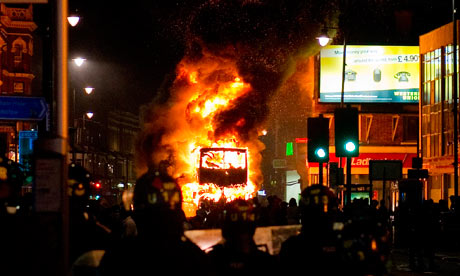 |
| Rioters set a London bus on fire |
 |
| CarpetRight building in Tottenham the next morning |
 |
| Police clash with looters in Manchester |
In the meanwhile, I'm busy finishing off my dissertation and preparing to move to Limerick, Ireland, for the next stage in my formation - I'll be teaching at the Jesuit comprehensive college there.
Life goes on.
Monday, 18 July 2011
On Spiritual Communion
A guest post from my fellow-Jesuit and Catching Fire co-blogger, Samuel Overloop SJ.
Roberto Beretta, an Italian journalist who writes for catholic newspapers and journals, attacks in no unclear terms the traditional practice of spiritual communion. He expresses his perplexity with this practice which he calls "one of the most subtle aberration of Christianity". I beg to differ.
For those not familiar with the practice of spiritual communion, it is often in the form of a small prayer which one says when not being able to receive communion at Mass. The purpose is to express on the one hand the desire to be united with Jesus in the sacrament of the Eucharist and, on the other hand, to express the belief that one is already in communion with Jesus.
Beretta has basically two arguments. The first is that it 'renders abstract that which is eminently concrete', and second, that it is a practice that was influenced by Jansenist worries of having to be 'pure' in order to receive the sacrament. Let's take them in turn.
The first argument is based on the assumption that spiritual communion is a sort of Eucharistic communion without receiving the Eucharist. If that is the case, than one can receive the grace of the sacrament, namely the union with the Mystical body of Christ, without receiving the 'concrete' sacrament: res sine sacramentu. Granted that the assumption is right, the practice of spiritual communion is indeed pernicious and dangerous to the doctrine of the Eucharist. What need is there after all of going to Mass? Beretta writes that 'evidently' spiritual communion can not be compared to the sacrament. Hence it is a 'fake' sacrament and the practice should be reconsidered.
However, the assumption is false. Evidently, spiritual communion is different from Eucharistic communion. It is not intended as a para-sacrament and it never was. In the words of Aquinas spiritual communion is "an ardent desire to receive Jesus in the Holy Sacrament and a loving embrace as though we had already received Him". Spiritual communion is intimately connected to the Eucharistic communion, but not in the sense that Beretta sees that relation. Spiritual communion is not the reality without the matter, but an expression of the desire to receive Jesus in the Eucharist. So instead of undermining the doctrine and practice of the Eucharist, it strengthens it.
The second argument Beretta employs consists in rendering absurd and backward those who want to defend the practice of spiritual communion. It is based on a fallacy by association. It is true that the practice of spiritual communion has been abused by 'jansenist' currents in the Church. But by affirming such a thing without qualification Beretta taints the practice of spiritual communion with the label of backward, pre-conciliar, traditionalist, ... Since he does not present a real argument, let me just reply in his own coin. People who recommended spiritual communion were among others Thomas Aquinas, Theresia of Avila and John Paul II. Surely not all were tainted with the 'Jansenist' streak?
Conclusions? There is no contradiction between practising spiritual communion and being faithful to the doctrine and practice of the Eucharist. The two arguments Beretta presents are both flawed. Of course, every practice has its excesses but that is no reason to condemn a practice. I agree with Beretta's last comments, namely that we have to take a good look at our devotional practices. Not in order to reject them, however, but in order to renew them and root them again in the Gospel and in Him who is our Salvation.

Roberto Beretta, an Italian journalist who writes for catholic newspapers and journals, attacks in no unclear terms the traditional practice of spiritual communion. He expresses his perplexity with this practice which he calls "one of the most subtle aberration of Christianity". I beg to differ.
For those not familiar with the practice of spiritual communion, it is often in the form of a small prayer which one says when not being able to receive communion at Mass. The purpose is to express on the one hand the desire to be united with Jesus in the sacrament of the Eucharist and, on the other hand, to express the belief that one is already in communion with Jesus.
My Jesus, I believe that you are in the Blessed Sacrament. I love you above all things, and I long for you in my soul. Since I cannot now receive you sacramentally, come at least spiritually into my heart. As though you have already come, I embrace you and unite myself entirely to you; never permit me to be separated from you. Amen.
Beretta has basically two arguments. The first is that it 'renders abstract that which is eminently concrete', and second, that it is a practice that was influenced by Jansenist worries of having to be 'pure' in order to receive the sacrament. Let's take them in turn.
The first argument is based on the assumption that spiritual communion is a sort of Eucharistic communion without receiving the Eucharist. If that is the case, than one can receive the grace of the sacrament, namely the union with the Mystical body of Christ, without receiving the 'concrete' sacrament: res sine sacramentu. Granted that the assumption is right, the practice of spiritual communion is indeed pernicious and dangerous to the doctrine of the Eucharist. What need is there after all of going to Mass? Beretta writes that 'evidently' spiritual communion can not be compared to the sacrament. Hence it is a 'fake' sacrament and the practice should be reconsidered.
However, the assumption is false. Evidently, spiritual communion is different from Eucharistic communion. It is not intended as a para-sacrament and it never was. In the words of Aquinas spiritual communion is "an ardent desire to receive Jesus in the Holy Sacrament and a loving embrace as though we had already received Him". Spiritual communion is intimately connected to the Eucharistic communion, but not in the sense that Beretta sees that relation. Spiritual communion is not the reality without the matter, but an expression of the desire to receive Jesus in the Eucharist. So instead of undermining the doctrine and practice of the Eucharist, it strengthens it.
The second argument Beretta employs consists in rendering absurd and backward those who want to defend the practice of spiritual communion. It is based on a fallacy by association. It is true that the practice of spiritual communion has been abused by 'jansenist' currents in the Church. But by affirming such a thing without qualification Beretta taints the practice of spiritual communion with the label of backward, pre-conciliar, traditionalist, ... Since he does not present a real argument, let me just reply in his own coin. People who recommended spiritual communion were among others Thomas Aquinas, Theresia of Avila and John Paul II. Surely not all were tainted with the 'Jansenist' streak?
Conclusions? There is no contradiction between practising spiritual communion and being faithful to the doctrine and practice of the Eucharist. The two arguments Beretta presents are both flawed. Of course, every practice has its excesses but that is no reason to condemn a practice. I agree with Beretta's last comments, namely that we have to take a good look at our devotional practices. Not in order to reject them, however, but in order to renew them and root them again in the Gospel and in Him who is our Salvation.

Tuesday, 5 April 2011
Is Cosmopolitanism the new "Catholic guilt"?
... cosmopolitan emotions are most likely to develop when actors believe that they are causally responsible for harming others and their physical environment
-- Linklater, Andrew (2006) ‘Cosmopolitanism’, in A. Dobson and R. Eckersley (eds), Political Theory and the Ecological Challenge. Cambridge: Cambridge University Press. p.3
Cosmopolitanism is the philosophical position that all human beings belong to a single community and our obligations are essentially not bound by culture or nation.Typical concerns of cosmopolitans include world poverty, world government and international justice. Opposed to cosmopolitanism are positions like communitarianism (moral obligations are determined by and limited to one's culture) and post-modernism (nothing matters).
Cosmopolitans like Thomas Pogge (see my friend Eddie's post here) make the point that much of the Western world is actively responsible for much Third World poverty and suffering.
Hence the question - has cosmopolitanism replaced the fabled "Catholic guilt"?
Sunday, 13 March 2011
Jesuit Education Redux
"We want human excellence" - Fr. Adolfo Nicolas SJ, Superior General of the Jesuits.
Monday, 28 February 2011
Catching Fire
In my last post, I mentioned a project I was working on. Well, I'm now at liberty to reveal what it is... (cue drumroll...) another blog! (groan?!)
But in all seriousness, this is a different blog from my previous outings. It's called Catching Fire (check it out here) after a poem by fellow-British Jesuit Gerard Manley Hopkins. It's a group blog run by myself and five other Jesuit scholastics (seminarians) studying in London. Like An Unworthy Knight, it offers a faith-inspired look at culture and contemporary life but it may not deal as much with aspects of Jesuit living.
I will still continue to blog occasionally on AUK, but (for the next few months, at least) the majority of my posts would be on CF. So add it to your Blogroll / Favourites / Bookmarks / Feed / whatever and enjoy!
Sunday, 30 January 2011
Disappearing Act
Just in case you're wondering where I've been all these months, I returned to London in September and started my MA in Philosophy at Heythrop College. (That also explains why the header's changed!)
Over the next few days, I'm experimenting with my blog layout for another project I'm working on (no details yet - spoilers!). Keep calm and carry on ;-)
Over the next few days, I'm experimenting with my blog layout for another project I'm working on (no details yet - spoilers!). Keep calm and carry on ;-)
Friday, 6 August 2010
Inter-religious Dialogue Survey
A classmate and fellow-scholastic of mine from DNC is doing a survey on inter-religious dialogue and needs responses from non-Christians:
Tuesday, 20 July 2010
World Cup Fever
In the first semi-final, Brazil and Spain were deadlocked until the last minute of normal time, when Spain struck what seemed to be the winner, only for their fans to watch in horror as one of the Spanish defenders turned the ball pass his own keeper two minutes later. And so, on to extra time. In the last minute (again!) of extra time Spain scored a controversial goal with the Brazilian keeper claiming he was kicked in the ear while he scrambled to get a hold of the ball in a goal-mouth scrimmage. In the second semi-final, Germany scored two goals in the first half and, although Argentina fought back to reduce the deficit to one goal, held on for the win.
Sarvodaya is now a Plus Two School
Flash News: Sarvodaya, the Jesuit school in Wayanad, Kerala, has been approved to offer Plus Two courses (the equivalent of a Sixth Form College) by the State Education Department. This means that Sarvodaya students can now continue to study here and reap the benefits of Jesuit pedagogy instead of having to scour around for pre-university seats.
Coming on the heels of approval of its 'minority school' status last week by the central Minorities Commission, this is a big development in the 20-year history of Jesuit involvement with the school. Having minority status means the school is protected by the Constitutional rights of minorities to preserve, propagate and develop their own culture and values. In practice, one of the most significant consequences is that the management of the institution in question has greater control over staff appointments. Thus, the Jesuit identity of the school can be further strengthened and the Ignatian outlook of our staff better developed.
Sunday, 4 July 2010
A Week at Eachome
As I come to the end of a physically tiring yet psychologically enervating week where I found myself as an adhoc substitute teacher (English, IT, Maths, Music!), I just wanted to share a few highlights of the week that was at Sarvodaya, Eachome:
Characteristics of Jesuit Education
(Below is an abridged/edited version of a speech I gave at the awards function last Tuesday at Sarvodaya High School.)
Respected Chairman, distinguished guests, parents, teachers and my dear friends.
We are gathered here today for two reasons. One, to inaugurate the school club activities for this year. Two, to felicitate the students who obtained high grades at last year's SSLC (Kerala-equivalent of the O-Levels) examinations. The Chairman has already spoken to you about the first, so I would like to focus my speech today on the second.
First, let me once again congratulate the students who received 9 or 10 A+ grades in this year's examinations. Your parents are proud of you; your teachers are proud of you and your juniors gathered here today are proud of you. We wish you all the best for your future studies and careers.
All of the students here today – past and present – are part of a large community of nearly 30 lakh (3 million) students who study at Jesuit educational institutions around the world. Wherever you go, you can always say with pride that you studied at Sarvodaya High School, a Jesuit educational institution. Last year, I worked at our Jesuit school in South London (Sacred Heart College, Wimbledon aka Wimbledon College) where the students look different from you, speak a different language, come from a different culture, do different things with their spare time etc. Nevertheless, you are joined with them by the common bond of your Jesuit education. Studying at a Jesuit school means that people will have certain expectations of you. I would like to focus today on three characteristics you are expected to acquire by the end of your studies in a Jesuit school – excellence in learning, excellence in life and becoming boys and girls (or men and women) for others.
Excellence in learning is not about bookish knowledge or remembering facts. It means that people expect you to have depth of understanding, of insight in all that you have learnt here. It also means that you are expected to have breadth of knowledge – about the world, about society, about yourselves. This can only happen if you are constantly keeping yourself aware of what is happening around us; by reading the daily newspapers, for instance. Excellence in learning can only be achieved if you apply yourselves with discipline to your studies.
Discipline is also part of the second point I want to raise – excellence in life. People will expect from Jesuit students excellence in all aspects of life – work, extra-curricular activities, arts, music, drama etc. In that respect, the other purpose of today's function – inaugurating the club activities – plays a crucial role. In your time here, I hope you will participate in these wholeheartedly. But excellence in life is not just about excellence in achievement. It also means excellence in virtue. As students of a Jesuit school, people will expect you to be men and women of kindness, of courage, of wisdom, of gratitude.
This brings me to the last point – being boys and girls for others. If you have come out of a Jesuit school with a selfish mindset, then our education has not done its work. Concern for others is an absolute must. You can begin in small ways: if you notice a classmate is lagging behind on school work, take the time to help her/him catch up. These three aspects – excellence in learning, excellence in life and concern for others must be part of your everyday life in this school.
Congratulating our former students once again for their achievements in the examinations, I conclude my speech.
Subscribe to:
Posts (Atom)